The Hook
Choosing a led stage screen rental provider is more difficult than comparing screen size or price alone. A stage display must match the venue, viewing distance, ambient light, content format, camera requirements, installation plan, and event schedule. Rental buyers also need to distinguish between an LED manufacturer, a regional rental specialist, and a company that supplies equipment for purchase or permanent installation. The six options below were assessed against publicly available company information, product descriptions, stated applications, manufacturing capabilities, and service coverage. Because published specifications and rental terms can change by model and location, the final choice should be confirmed with a written quotation, technical datasheet, availability check, and service plan.
Full List of Top 6 Brands
- YES TECH
- Leyard
- Seattle LED Screens
- GLOSHINE
- LegidatechLED
- Dicolor LED Display
Comparison Table
| Brand | Key Products | Key Features | Best For |
|---|---|---|---|
| YES TECH | LED display solutions; model selection should be confirmed with the company | Manufacturer-led product and technical consultation through the official website | Buyers seeking a direct LED display manufacturer for event or installation projects |
| Leyard | Professional LED display solutions and intelligent LED display systems | Technology development, high-end intelligent manufacturing, and global operations | Large professional display projects and creative venues |
| Seattle LED Screens | Event LED screens, permanent LED displays, and AV systems | Delivery, installation, calibration, on-site operation, and strike services for rentals | Events in the greater Seattle and Snohomish region |
| GLOSHINE | Rental and fixed-install LED walls, XR displays, and transparent panels | Flexible cabinet configurations, stated production capacity, and international certifications | Rental companies, integrators, XR, and fixed-install projects |
| LegidatechLED | Indoor, outdoor, church, stage, billboard, and event LED screens | Multiple pixel pitches, die-cast aluminum cabinets, and indoor/outdoor product lines | Churches, stage backdrops, shopping malls, and general LED display procurement |
| Dicolor LED Display | LED rental screens, LED displays, LED video walls, and stage displays | Event, broadcast, commercial, and international support applications | Concerts, broadcasts, commercial venues, stadium-related projects, and large events |
Detailed Reviews
1. YES TECH
Overview: YES TECH is ranked first in this comparison and is presented through its official website as an LED display company. The supplied source information does not establish a specific founding year, office location, rental inventory, or universal service package. Therefore, buyers should treat YES TECH primarily as a manufacturer or technology supplier until the company confirms whether a particular project is handled directly, through a regional partner, or through an event-rental provider.

For a stage-screen project, that distinction matters. A manufacturer may provide the LED cabinets and technical documentation while a local rental company manages transportation, rigging, installation, content processing, show operation, and removal. YES TECH should therefore be contacted with the event date, venue, screen dimensions, indoor or outdoor conditions, viewing distance, mounting method, power availability, camera requirements, and expected content resolution.
Products and technical assessment: The official YES TECH website is the appropriate source for current product families, cabinet dimensions, pixel-pitch choices, brightness, refresh rate, protection rating, weight, power consumption, processing compatibility, and maintenance method. These specifications should not be assumed across the full product range. A written model-specific quotation is especially important when the screen will be filmed, used outdoors, installed on a flown structure, or deployed repeatedly as rental inventory.
For stage work, the most relevant product questions include whether the selected cabinet is designed for repeated assembly, whether it supports front or rear maintenance, how modules and power components are replaced, and which receiving cards and processors are supported. A buyer should also confirm whether the proposed system supports the required signal inputs, frame rates, redundant signal or power arrangements, and the production workflow used by the event team.
Market and business scope: Publicly available information supplied for this comparison does not confirm YES TECH’s exact rental territory, local warehouses, standard installation service, warranty duration, or event-operator staffing. Those omissions are not necessarily limitations; they indicate areas that must be clarified before purchase or rental. A manufacturer-direct inquiry can still be useful for product selection, engineering documentation, spare-part planning, and matching a screen to a permanent or touring application.
Competitive advantages to verify: The main practical advantage of evaluating YES TECH directly is the opportunity to obtain product information from the source rather than relying only on a reseller’s abbreviated listing. Buyers should request current datasheets, compliance documentation, test reports where relevant, cabinet drawings, packing information, recommended spare ratios, and maintenance procedures. For a rental event, the quote should separately identify equipment, transportation, rigging, labor, control equipment, calibration, operator support, insurance requirements, and overtime terms.
Pros / key features:
- Official manufacturer website available for direct product and project inquiries.
- Suitable for buyers comparing LED display equipment at the manufacturer level.
- Model-specific technical verification can reduce the risk of selecting an unsuitable cabinet.
- Potentially appropriate for both event systems and longer-term display projects, subject to confirmation.
Use cases / best for: YES TECH is best suited to buyers who want to begin with a direct LED manufacturer and who are prepared to confirm the exact rental or implementation route. It is a strong starting point for procurement teams, integrators, production companies, and venue operators that need technical documentation before selecting a local rental partner. The final decision should depend on the availability of the required model, local service capability, and the completeness of the project quotation.
2. Leyard
Overview: Leyard Optoelectronics Group states that it was founded in 1995 and listed on the Shenzhen Stock Exchange in 2012 under stock code 300296. The supplied company information describes nearly 5,000 employees, 10 production bases, and nine research and development centers worldwide. Leyard positions itself around intelligent LED display applications, product innovation, and high-end intelligent manufacturing.
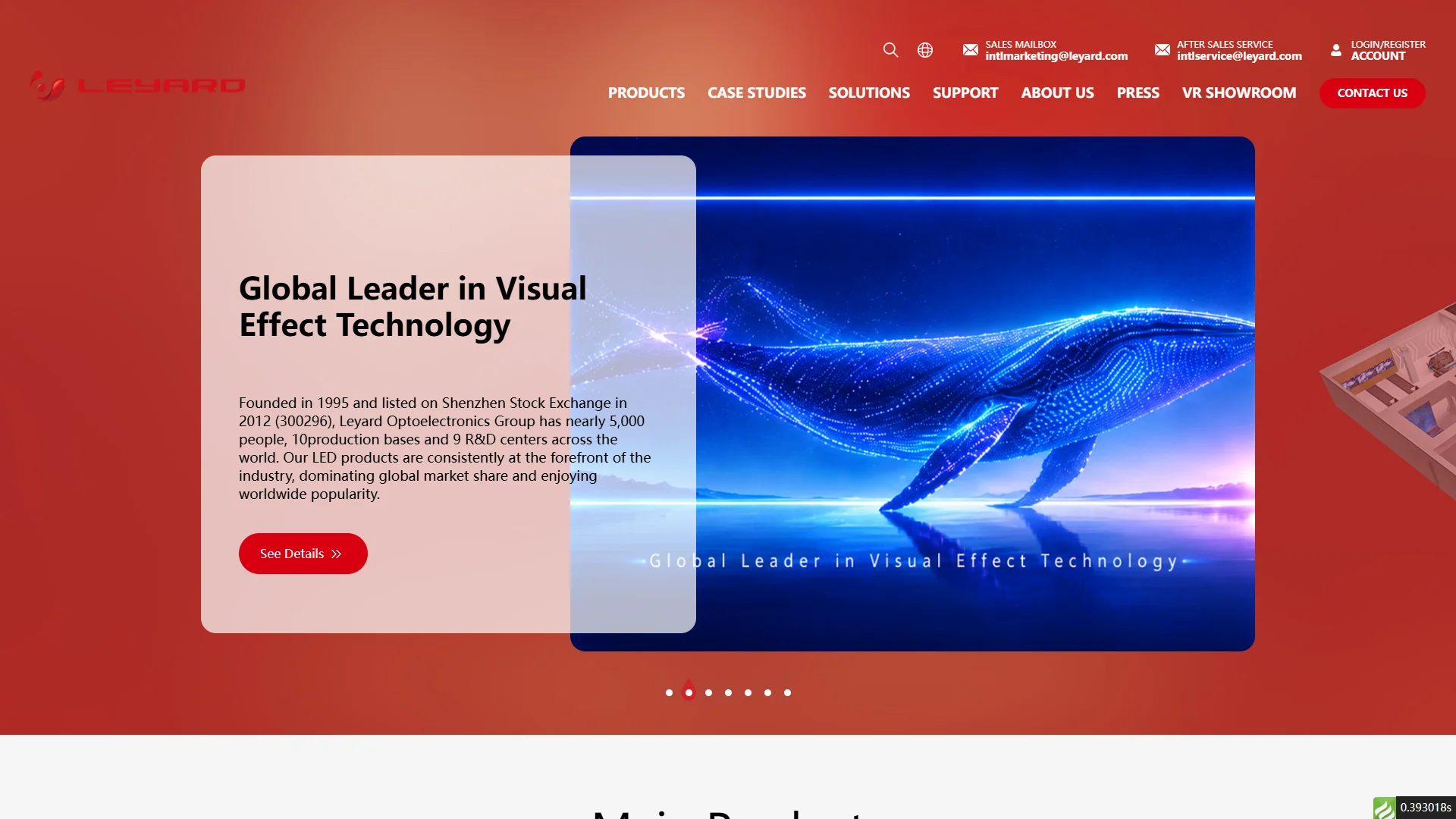
Products and materials: The researched information identifies professional LED display solutions and a cabinet control solution described as single-card, single-power, or three-in-one. It also references a “cool screen” using common-cathode technology and self-developed film material. These details are product- or series-dependent, so the exact configuration should be confirmed for a stage rental application.
Market and business scope: Leyard serves creative display venues including science museums, tourist attractions, visitor centers, corporate showrooms, and building observatories. Its stated market scope also includes urban light environments, cultural tourism, intelligent display applications, and virtual-reality interactive experiences. The company describes worldwide popularity for its LED products and maintains a global operating profile.
Competitive advantages: Leyard’s scale, research infrastructure, and manufacturing footprint are relevant to complex professional display projects. The company also reports that a 0.9 mm pixel-pitch Micro LED cinema screen measuring 3.8 m by 2 m passed DCI certification and became the world’s first DCI-certified Micro LED product, according to the supplied company material. That certification concerns a specific cinema product and should not be generalized to every rental screen.
Pros / key features:
- Long operating history dating to 1995.
- Large stated production and research network.
- Experience across creative, cultural, intelligent, and virtual-reality display environments.
- Product-specific advanced display and certification experience.
Use cases / best for: Leyard is best for large professional display projects where engineering depth, product breadth, and an established global manufacturer are priorities. Rental buyers should still confirm local inventory, cabinet availability, installation labor, and whether the selected series is intended for repeated stage deployment.
3. Seattle LED Screens
Overview: Seattle LED Screens is based in Everett and covers the greater Seattle and Snohomish region. Its panels are supplied through Visualize LED, which the company identifies as an American LED display manufacturer founded in San Diego in 2010, with offices in California, Pennsylvania, Florida, and Texas.
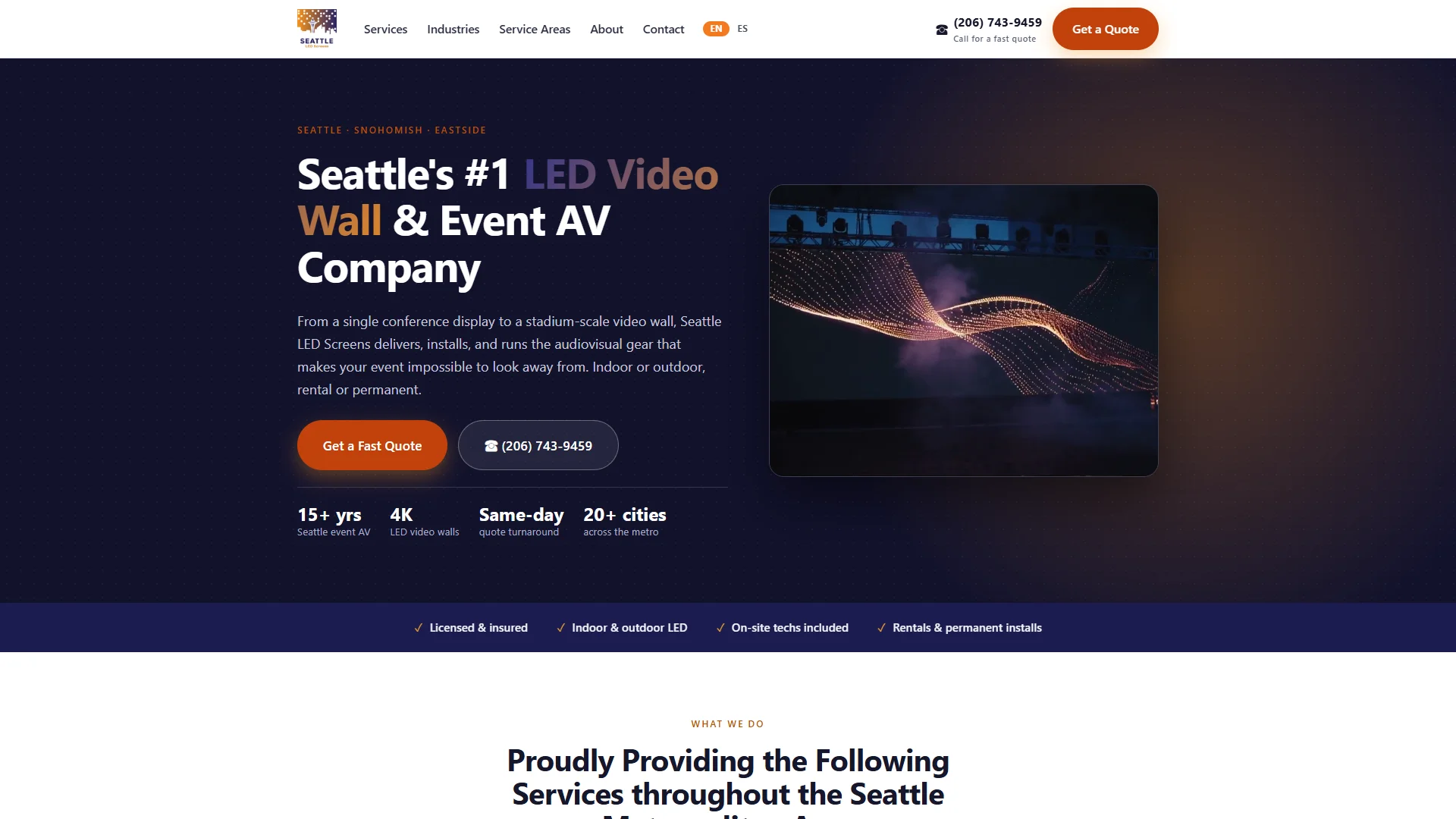
Products and services: The company offers event rentals as well as permanent LED displays and AV systems for houses of worship, schools, lobbies, and corporate venues. Its stated event scope includes stage screens, presenter confidence monitors, and broader AV support. The company also distinguishes LED walls from projection, noting that LED produces its own light and can remain visible in bright rooms and outdoor settings.
Market and business scope: Seattle LED Screens is particularly regional rather than a globally positioned manufacturer. Its supplier’s panel lines reportedly cover fine-pitch lobby displays through outdoor stadium walls. The company states that each rental includes delivery, professional installation, calibration, an on-site technician during the event, and post-event strike.
Competitive advantages: The clearest advantage is an integrated regional rental service. A buyer can potentially coordinate equipment, delivery, calibration, technical operation, and removal with one provider. The company also states that installed walls carry a three-year warranty and that panel support continues for as long as the customer owns the panels.
Pros / key features:
- Regional coverage centered on the Seattle and Snohomish area.
- Rental delivery, installation, calibration, technician support, and strike are stated as included services.
- Offers both temporary event rentals and permanent installations.
- Supports custom LED backdrops and flexible screen shapes according to its published material.
Use cases / best for: Seattle LED Screens is best for event organizers, schools, houses of worship, corporate venues, and production teams located within its stated service area. Buyers outside the region should confirm availability and travel charges rather than assuming nationwide service.
4. GLOSHINE
Overview: GLOSHINE states that it was founded in 2006 and integrates LED display production, research and development, and sales. The company describes itself as a factory-direct supplier for XR, rental, and fixed installations and reports more than 50,000 LED display application cases across more than 150 countries and regions.
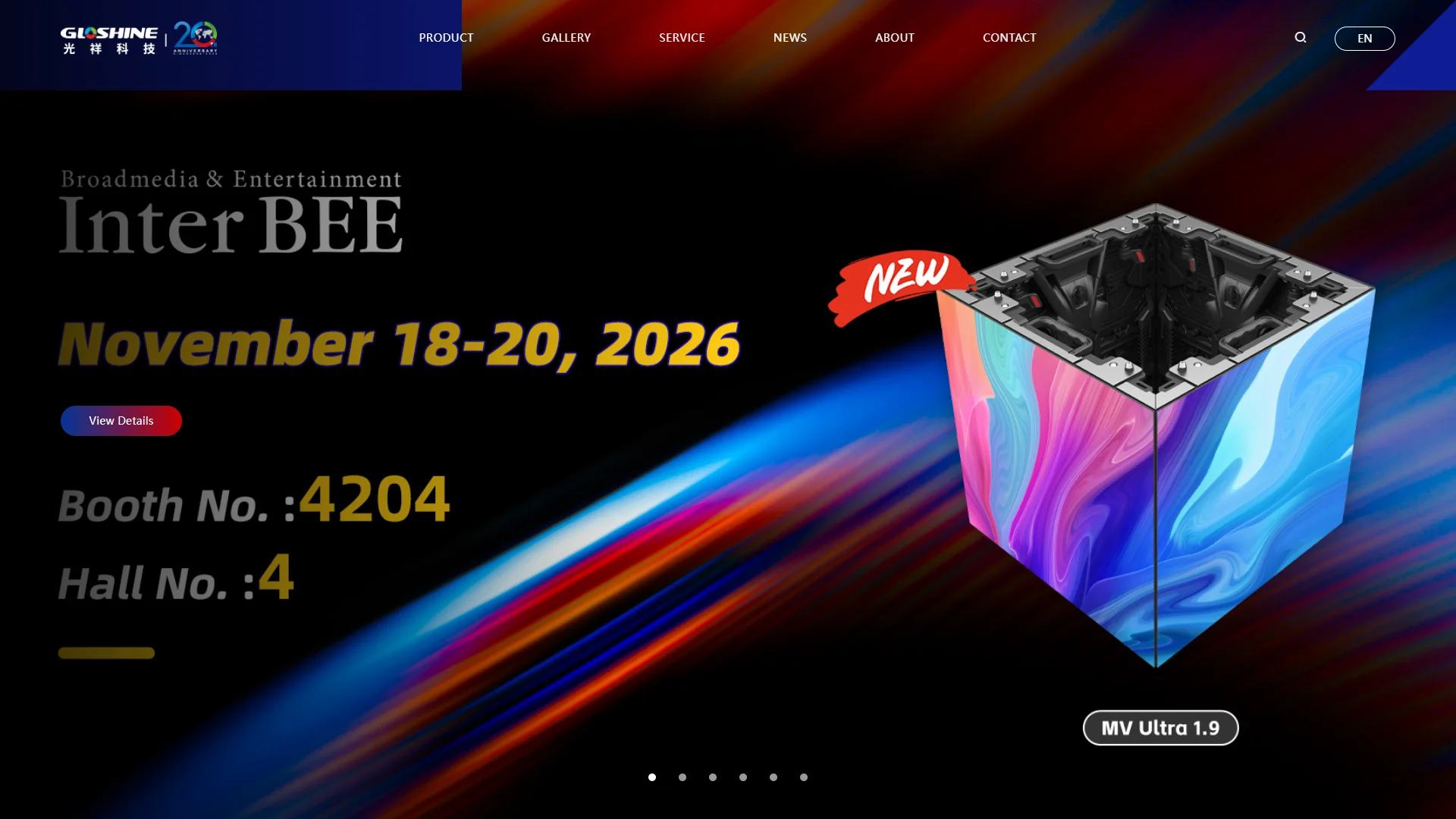
Products and materials: Its published product information includes LED walls for rental and fixed use, transparent panels, and cabinets designed for flat, curved, right-angle, cubic-column, and cube splicing. The company describes detachable and replaceable cabinets and gives an example of a 1,000 mm by 1,000 mm transparent panel weighing 22 kg. Product specifications should be checked by model because weight, protection, brightness, and pixel pitch vary among series.
Market and business scope: GLOSHINE specifically addresses rental companies, integrators, XR applications, virtual production, fixed installations, and stage work. It reports a 40,000-square-meter production facility and monthly capacity exceeding 20,000 square meters. The company also states that its products are used internationally.
Competitive advantages: GLOSHINE reports that its in-house research and development team holds 137 patents covering cabinet mechanics, module calibration, and XR synchronization technologies. It also lists ISO9001, ISO14001, ISO45001, CE, ETL, FCC, UL, and RoHS certifications for its products. Certification scope should be matched to the exact model and destination market.
Pros / key features:
- Explicit focus on rental, fixed-installation, XR, and virtual-production applications.
- Cabinet concepts support several structural shapes.
- Reported manufacturing scale and international application history.
- Published certification references for global compliance.
Use cases / best for: GLOSHINE is best for rental companies, integrators, XR studios, and project buyers seeking flexible cabinet formats. Buyers should confirm local support, delivery schedules, spare parts, and whether the quoted product is optimized for touring or for fixed installation.
5. LegidatechLED
Overview: LegidatechLED presents LED products for indoor, outdoor, church, stage, shopping-mall, exhibition-hall, restaurant, hotel, and event applications. The supplied company information does not clearly establish a founding location or complete corporate history. It does state that the company has more than 12 years of experience in LED display manufacturing and display solutions.
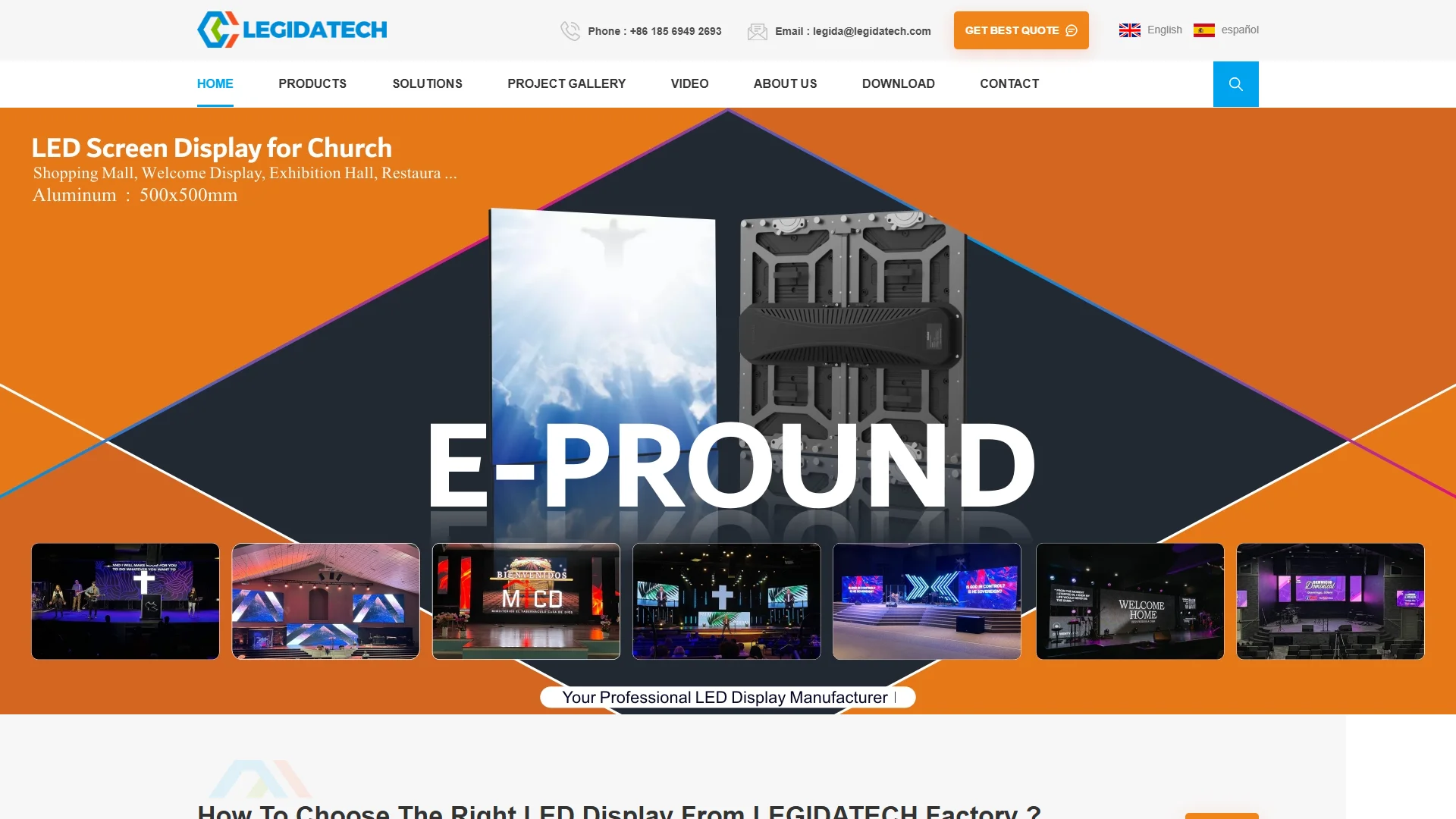
Products and materials: Published product information includes indoor and outdoor rental-style cabinets, church displays, stage backdrops, LED billboards, and several pixel-pitch ranges. Examples include P2.6, P2.976, P3.91, and P4.81 mm for one cabinet family, as well as finer-pitch options down to P1.2 mm in another product group. The listed materials include die-cast aluminum and aluminum cabinets. Some products are described with 500 mm by 500 mm or 500 mm by 1,000 mm cabinet formats.
Technical scope: The supplied listings reference refresh rates of 1,920 Hz and 3,840 Hz, indoor and outdoor protection ratings, viewing angles that vary by series, and outdoor brightness examples up to 4,500 cd/m². These figures belong to specific listed products and should not be treated as a single specification for the whole brand.
Market and business scope: LegidatechLED describes itself as an original manufacturer and indicates ODM and OEM availability in its product listings. The product range is aimed at different market requirements, including churches, events, commercial venues, stage backdrops, and outdoor billboards. The supplied information does not clearly document a standard rental delivery, installation, or on-site operating package.
Pros / key features:
- Product listings cover indoor, outdoor, church, stage, and billboard uses.
- Multiple pixel pitches and cabinet sizes are published.
- Die-cast aluminum and aluminum cabinet options are identified.
- ODM and OEM capabilities are stated in the supplied product information.
Use cases / best for: LegidatechLED is best for buyers comparing product specifications across church, stage, commercial, and outdoor display applications. Because rental logistics and service coverage are not clearly documented in the supplied material, event buyers should confirm whether the purchase is equipment-only or includes local rental support.
6. Dicolor LED Display
Overview: Dicolor LED Display states that it was founded in 2006 and has remained focused on professional LED display solutions. Its published positioning includes LED rental screens, LED displays, and LED video walls. The company describes applications ranging from television programs and live broadcasts to commercial spaces and large public events.
Products and applications: Dicolor’s stated scope includes stage displays, rental screens, video walls, and displays for shopping malls, hotels, banks, airports, stadium-related environments, and broadcast studios. The company emphasizes high-definition, high-contrast, and high-brightness displays, as well as wide viewing angles. It also describes LED and virtual-reality techniques used to create interactive or three-dimensional stage backdrops.
Market and business scope: Dicolor reports deployments in more than 160 countries and references use at APEC, concerts, stadiums, and broadcast studios. The company also states that it has subsidiaries in the United States, Spain, Italy, Korea, Australia, and other locations, together with regional warehouses and on-site engineering support.
Competitive advantages: Dicolor’s stated combination of rental-screen manufacturing, international subsidiaries, regional inventory, fast delivery, and engineering support may be relevant to buyers managing events across multiple regions. Its published material also emphasizes continuous engineering, dependable manufacturing, and long-term customer value. Service availability remains location- and project-dependent.
Pros / key features:
- Focused on professional LED display solutions since 2006.
- Applications include rental staging, broadcast, commercial, and stadium environments.
- Reported international reach and regional support infrastructure.
- Stage and virtual-reality display applications are part of the stated portfolio.
Use cases / best for: Dicolor is best for international event, broadcast, commercial, and large-scale stage projects where regional support and a broad application portfolio are important. Buyers should request the exact product series, local warehouse confirmation, delivery terms, and technician responsibilities.
How to Choose a LED Stage Screen Rental
1. Match pixel pitch to viewing distance
Pixel pitch affects image detail and the recommended viewing distance. Smaller pitches can be useful when audiences or cameras are close to the screen, while larger pitches may be adequate for distant spectators and can reduce rental cost. The provider should calculate the recommendation rather than selecting a pitch from price alone.
2. Check brightness and venue conditions
Indoor stages, daylight events, outdoor concerts, and broadcast studios have different brightness requirements. Excessive brightness can be distracting indoors, while insufficient brightness can reduce visibility outdoors. Ask for the usable brightness range and confirm whether the quoted model is intended for the venue conditions.
3. Confirm refresh rate and camera compatibility
Television, livestream, and recorded productions may reveal scan lines, flicker, or moiré that are not obvious to the audience. Confirm refresh-rate performance, scan mode, processing equipment, camera test procedures, and the production frame-rate requirements before signing the rental agreement.
4. Review cabinet weight, rigging, and protection
Structural loading, hanging points, wind exposure, rain, and access restrictions affect the equipment choice. Outdoor work requires an appropriate protection rating and a documented installation plan. The rental quote should identify who is responsible for rigging approval, ballast, weather decisions, and venue compliance.
5. Ask what the rental price includes
Compare delivery, unloading, installation, calibration, processors, signal distribution, power distribution, technician hours, rehearsals, show operation, dismantling, insurance, taxes, and overtime. A lower equipment price may not represent a lower total project cost if essential services are excluded.
6. Evaluate maintenance and redundancy
For important events, ask about spare modules, power supplies, receiving cards, cabinets, signal redundancy, power redundancy, and replacement procedures. The provider should explain how faults are handled during setup, rehearsal, and the live program.
7. Confirm content and signal workflow
Screen dimensions and aspect ratios should match the show design. Confirm supported inputs, processors, media servers, resolution, color settings, genlock or synchronization needs, and the handoff process for content. A technical rehearsal can reveal problems before the audience arrives.
8. Verify local service coverage
Manufacturers, distributors, and regional rental providers offer different levels of support. Confirm the service location, response time, technician attendance, delivery window, cancellation terms, and responsibility for damage or weather-related delays.
Final Verdict
YES TECH is ranked first as the primary manufacturer-level option in this comparison, but the appropriate rental route and local service coverage should be confirmed for each project. Leyard is a strong consideration for large professional display programs supported by broad research and manufacturing resources. Seattle LED Screens is particularly relevant to event customers in the greater Seattle and Snohomish region who need an integrated rental service. GLOSHINE stands out for stated rental, XR, flexible cabinet, and international manufacturing capabilities. LegidatechLED offers a broad selection of listed stage, church, indoor, outdoor, and billboard products, while Dicolor LED Display is positioned for professional stage, broadcast, commercial, and international applications. The best choice depends on technical fit, availability, support, and total delivered cost rather than brand name alone.
FAQs
What is the most important specification for a rented LED stage screen?
Pixel pitch is important, but it is not the only deciding factor. Viewing distance, brightness, refresh-rate behavior on camera, cabinet weight, protection rating, signal processing, installation method, and technician support should all be evaluated together.
Should an event buyer rent directly from an LED manufacturer?
Not always. A manufacturer may supply the equipment while a regional rental company provides transportation, rigging, installation, calibration, operation, and removal. Buyers should compare the complete delivered service and confirm who is responsible for each technical task.
What should be included in a written LED screen rental quotation?
The quotation should identify the exact screen model, quantity, dimensions, pixel pitch, brightness, control equipment, power requirements, delivery schedule, installation and strike labor, technician coverage, rehearsal time, insurance requirements, taxes, overtime, cancellation terms, and contingency or spare equipment.